
Email: sales@xtalong.com Tel: +86-28-80192520
Email: sales@xtalong.com Tel: +86-28-80192520
Frequency Synthesizing in Crystal Oscillators: A Guide to Dividers, Multipliers, and PLLs
Introduction
In modern electronic design, the stability of a quartz crystal oscillator is legendary. However, while quartz crystals provide an incredibly precise reference, their physical properties often limit their fundamental frequency range—typically between 32.768 kHz and 200 MHz. To reach the Gigahertz (GHz) ranges required for 5G, satellite, and high-speed computing, engineers utilize Frequency Dividers, Multipliers, and Phase-Locked Loops (PLLs).
1. Frequency Dividers: Precision Clock Distribution
A Frequency Divider is a circuit that takes an input frequency (Fin)and generates an output frequency (Fout) that is 1/N of the original.
How it works: When a quartz crystal is energized, it vibrates at a fixed frequency. The high-frequency pulse signal is fed into the divider, which counts the pulses and triggers an output after a set number of cycles (N)
Key Benefit: Dividing frequency doesn't just lower the rate; it also effectively "spreads out" the jitter, often improving the period stability for sensitive microcontrollers and Real-Time Clocks (RTCs).
2. Frequency Multipliers: Reaching High-Frequency Peaks
A Frequency Multiplier does the opposite: it changes the frequency to N times the input (Fin* N)
Why we need it: While LC oscillators can reach high frequencies, they lack the stability of quartz. Conversely, quartz crystals have high stability but low fundamental frequencies. Multipliers bridge this gap.
The Trade-off: The main challenge with simple multipliers is Phase Noise. When you multiply a frequency by N, the phase noise power typically increases by 20 log(N) dB .This is why high-end RF designs require specialized low-noise multipliers.
3. Phase-Locked Loop (PLL): The Versatile Synthesizer
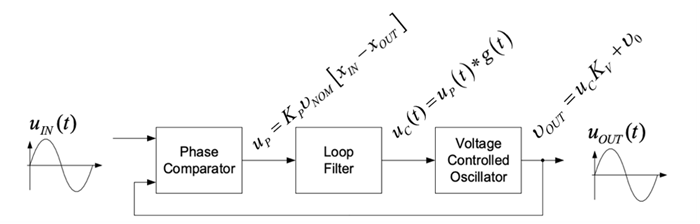
A PLL is a sophisticated closed-loop feedback system that combines the stability of a crystal with the flexibility of a Voltage Controlled Oscillator (VCO).
The Four Core Components of a PLL:
Phase Detector (PD): Compares the input reference (from the crystal) with the feedback signal.
Loop Filter (LPF): Cleans the error signal to provide a smooth control voltage.
VCO: The "heart" that outputs a periodic signal based on the input voltage.
Feedback Divider: Allows the VCO to run at a multiple of the crystal frequency, then "locks" it back to the reference.
A reference oscillator .
Comparison Table: Divider vs. Multiplier vs. PLL:
| Feature | Frequency Divider | Frequency Multiplier | Phase-Locked Loop (PLL) |
| Output Frequency | fin/N | fin×N | Variable (M/N×fin) |
| Circuit Type | Open Loop (Digital) | Open Loop (Analog/Non-linear) | Closed Loop (Feedback) |
| Phase Noise | Improved | Degraded (20logN) | Optimized via Loop Filter |
| Main Advantage | Simplicity & Jitter reduction | High-frequency reach | Flexibility & Frequency Agility |
| Complexity | Low | Medium | High |
Real-World Application Scenarios
A. 5G Base Station Timing (OCXO + Multiplier/PLL)
In 5G infrastructure, a 10MHz Oven Controlled Crystal Oscillator (OCXO) serves as the stable heart. However, the system requires 2.5GHz or 5GHz carriers. A combination of PLLs and Multipliers is used to "up-convert" the stable 10MHz signal to GHz levels while maintaining ultra-low phase noise for data transmission.
B. Consumer Electronics & IoT (Crystal + Divider)
Most microcontrollers (MCUs) run at lower speeds to save power (e.g., 8MHz or 32kHz). A single high-frequency crystal can be used with internal Dividers to provide different clock speeds to various parts of the chip, ensuring all components stay synchronized without needing multiple crystals.
C. Programmable Oscillators (PLL Technology)
Programmable oscillators use internal PLLs to offer customers "any frequency" (e.g., 148.3516 MHz) from a standard 25MHz crystal blank. This allows for fast prototyping and reduces the need for custom-cut quartz crystals.
Conclusion
Understanding the synergy between quartz crystals and frequency-modifying circuits is essential for any RF or digital designer. Whether you need the simplicity of a Divider, the power of a Multiplier, or the dynamic flexibility of a PLL, choosing the right architecture ensures your system remains stable, precise, and efficient.
You may want to know:
Contact: Katya Vane
Phone: +86-18884136031
Tel: +86-28-80192520
Email: sales@xtalong.com
Add: No.4 of XinHang Road, West of High-tech zone, Chengdu City 611731, China
We chat
