
Email: sales@xtalong.com Tel: +86-28-80192520
Email: sales@xtalong.com Tel: +86-28-80192520
(Passive crystal frequency measurement)
Accurate frequency measurement is essential to ensure that a Crystal Oscillator meets the timing requirements of a circuit. Whether you are verifying a Passive Crystal (Resonator) or an Active Oscillator (OSC), the measurement process must account for environmental factors and equipment limitations.
In this guide, we will discuss the tools, setups, and common pitfalls in measuring crystal frequencies.
To obtain a precise reading, you need professional-grade instruments:
Frequency Counter: Offers the highest precision for steady-state frequency analysis.
Oscilloscope: Useful for observing the waveform, amplitude, and start-up time, though slightly less precise for frequency than a counter.
Spectrum Analyzer: Best for measuring harmonics and phase noise.
High-Impedance Passive Probe: Crucial for minimizing the "loading effect."
Since an active oscillator outputs a buffered signal, measurement is relatively straightforward:
Power the oscillator with its rated voltage (e.g., 3.3V).
Connect the probe to the output pin (Pin 3).
Connect the ground lead to the nearest GND pin.
Tip: Most active oscillators can drive the capacitance of a standard 10x probe without significant frequency shift.
Measuring a passive crystal is trickier because it does not "vibrate" without an external drive circuit (usually inside the MCU).
Direct Probe Method: Attaching a probe directly to the crystal pins adds Probe Capacitance (CpCp). This extra capacitance will "pull" the frequency lower, leading to an inaccurate reading.
Non-Contact Method: Use a near-field probe or place the oscilloscope probe near the trace without touching it to observe the frequency without loading the circuit.
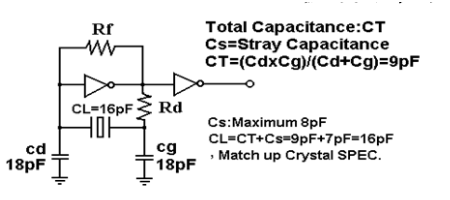
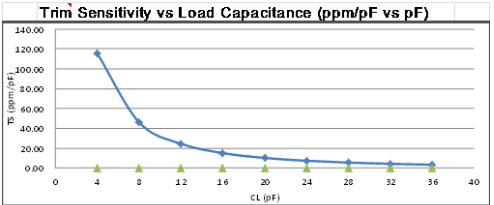
The most common error in frequency measurement is neglecting Load Capacitance (CLCL). If your crystal is rated for 12pF but your PCB and probe combined add 20pF, the measured frequency will be lower than the nominal value.
Crystals are sensitive to heat. Measuring a crystal immediately after soldering will yield an incorrect frequency. Always allow the PCB to reach room temperature (25°C) before testing.
Ensure your frequency counter is calibrated against a Rubidium or GPS-disciplined reference. Even a high-end counter can drift over time.
Pre-heat: Turn on the frequency counter for at least 15-30 minutes to stabilize the internal TCXO/OCXO.
Probe Setting: Use a 10X attenuation probe to reduce the capacitive loading on the circuit.
Grounding: Keep the ground lead as short as possible to avoid inductive ringing and noise pickup.
Capture: For MCU circuits, measure at the OSC_OUT pin rather than OSC_IN, as the output side is typically more robust against probe loading.
PPM Calculation: Use the formula:
PPM = [(Measured Frequency - Nominal Frequency) / Nominal Frequency] × 10^6
Frequency too low: Usually caused by excessive load capacitance or probe interference.
Frequency too high: May indicate the crystal is vibrating in a thickness-shear mode incorrectly or the CLCL is too low.
No oscillation: Check the drive level (DL) and ensure the supply voltage is clean.
Measuring crystal frequency is more than just reading a number; it is about understanding the interaction between the component and the test environment. By using high-impedance probes and accounting for load capacitance, you can ensure your system’s heartbeat is accurate.
Contact: Katya Vane
Phone: +86-18884136031
Tel: +86-28-80192520
Email: sales@xtalong.com
Add: No.4 of XinHang Road, West of High-tech zone, Chengdu City 611731, China
We chat
